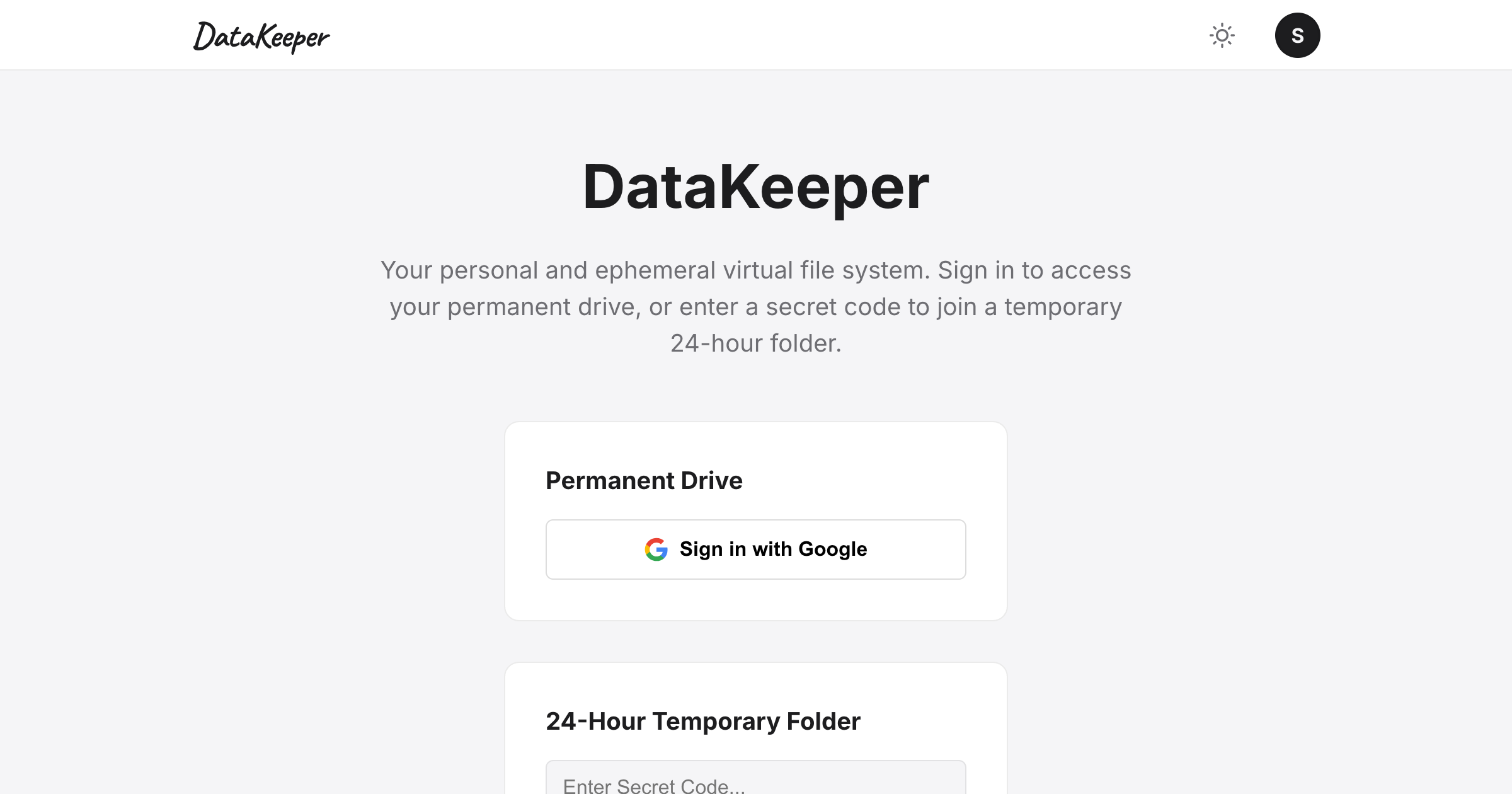
DataKeeper is a scalable, enterprise-grade cloud storage engine and file management system. Built with performance and massive scale in mind, it provides a seamless Google Drive-like experience for users to upload, organize, and securely share their data.
- 📁 Relational Virtual File System — Supports infinitely nested folder hierarchies using advanced SQL CTEs (Common Table Expressions).
- ⚡ Direct-to-Cloud Uploads — Bypasses server bottlenecks using Presigned URLs, allowing massive files to upload directly from the user's browser to the storage bucket via edge networks.
- 🔒 Enterprise Security & Isolation — Implements strict user isolation at the storage bucket level. Features robust authentication via Google OAuth and 24-hour self-destructing Secret Codes for temporary secure access.
- 🤖 Automated Maintenance — Built-in CRON jobs automatically sweep the database for expired links and execute multi-part chunk abortions on Cloudflare R2 to prevent storage leaks from interrupted network uploads.
- 📱 Responsive Drill-down UI — A highly polished, mobile-first interface featuring glassmorphism design, instant hover animations, and an intuitive breadcrumb-based drill-down navigation system.
- 👁️ Inline Media Engine — Real-time previews and playback for Videos, Audio, PDFs, and Images without needing to download them locally.
This project was engineered to solve complex cloud storage challenges (handling large files, preventing server payload limits, minimizing egress costs) by leveraging a distributed serverless architecture:
- Frontend & API: Next.js 15 (App Router, Server Actions, React Server Components)
- Database: Neon Serverless Postgres (Handling complex node trees, user relationships, and metadata)
- Blob Storage: Cloudflare R2 (S3-compatible, Zero-egress bandwidth costs, highly distributed CDN)
- Authentication: NextAuth.js (OAuth 2.0)
- Deployment: Vercel (Serverless edge functions and CRON automation)
- Bypassing Vercel Payload Limits: Standard serverless functions crash when handling files over 4MB. DataKeeper solves this by generating secure cryptographic signatures (Presigned URLs) on the backend, allowing the frontend to establish a direct PUT request to Cloudflare R2's servers.
- Cost Optimization (Zero Egress): By architecting the storage engine around Cloudflare R2 instead of AWS S3, the application achieves $0 bandwidth egress costs, allowing infinite scalability for downloads.
- Robust Orphan Cleanup: Implemented custom Node.js background scripts utilizing the
@aws-sdk/client-s3library to scan for incomplete multi-part uploads and orphaned blobs, guaranteeing perfect parity between the Postgres Database and the physical R2 storage. - Recursive SQL Queries: The file movement and folder deletion engine utilizes complex
WITH RECURSIVECommon Table Expressions in PostgreSQL to rapidly resolve nested parent-child paths without overwhelming the database with N+1 queries.
git clone https://github.com/AdityaPandey-DEV/datakeeper.git
cd datakeeper
npm installCreate a .env.local file and provide your credentials for Neon Postgres, Cloudflare R2, and Google OAuth:
# Database
POSTGRES_URL="postgresql://user:password@ep-your-db.region.aws.neon.tech/neondb?sslmode=require"

# Cloudflare R2
R2_ACCESS_KEY_ID="your_access_key"
R2_SECRET_ACCESS_KEY="your_secret_key"
R2_ENDPOINT="https://your-account-id.r2.cloudflarestorage.com"
R2_BUCKET_NAME="datakeeper"
R2_PUBLIC_URL="https://pub-your-custom-domain.r2.dev"

# Authentication
NEXTAUTH_SECRET="your_random_secret"
NEXTAUTH_URL="http://localhost:3000"
GOOGLE_CLIENT_ID="your_google_client_id"
GOOGLE_CLIENT_SECRET="your_google_client_secret"npm run devMIT