Keep shared Google Calendar events editable - #5569
Conversation


![builder-io-integration[bot]](https://avatars.githubusercontent.com/in/353721?s=60&v=4)
This comment was marked as outdated.
This comment was marked as outdated.
Sorry, something went wrong.

|
Here's a visual recap of what changed: Open the full interactive recap |
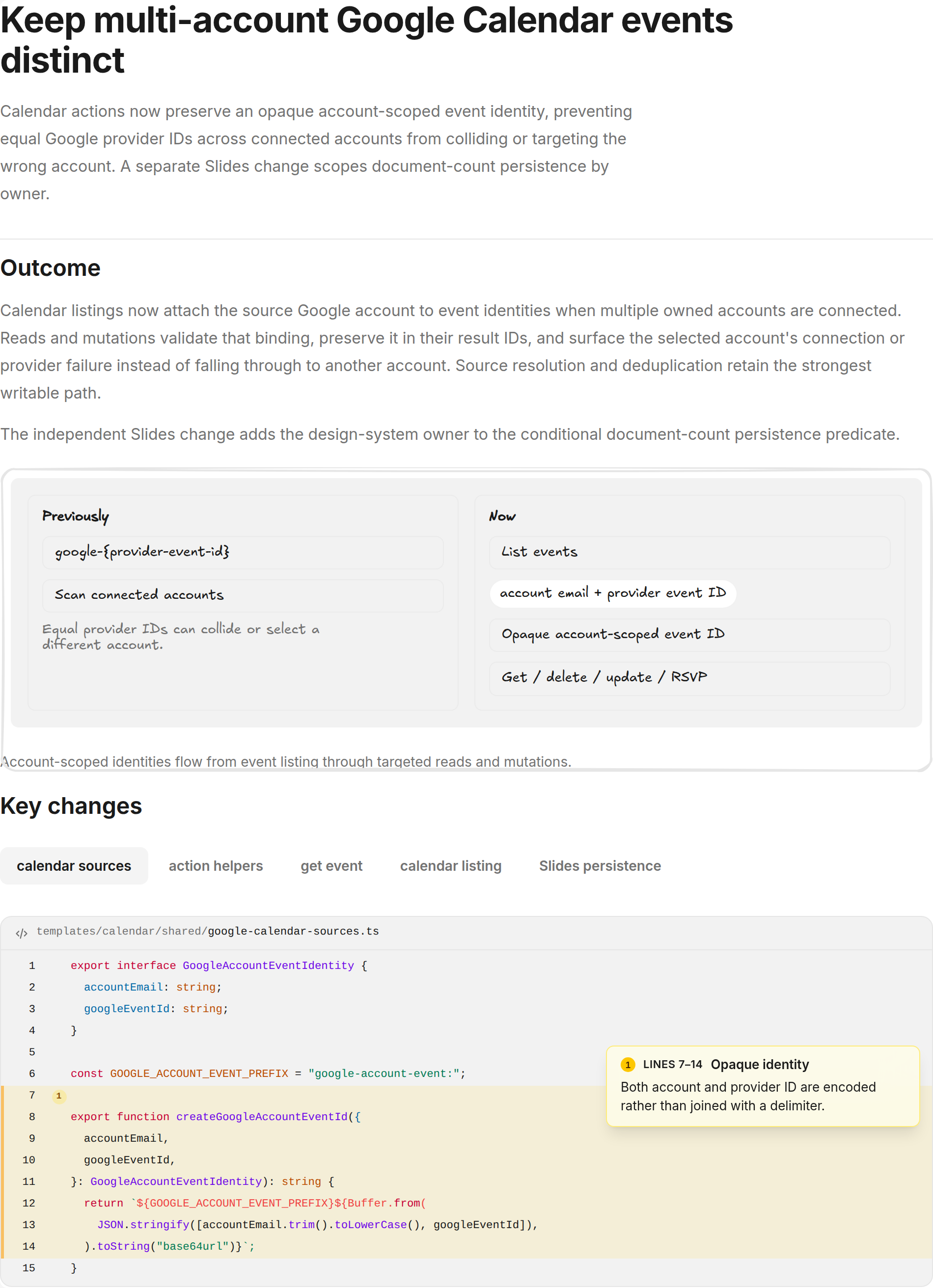

This comment was marked as outdated.
This comment was marked as outdated.
Sorry, something went wrong.
This comment was marked as outdated.
This comment was marked as outdated.
Sorry, something went wrong.
This comment was marked as outdated.
This comment was marked as outdated.
Sorry, something went wrong.
This comment was marked as outdated.
This comment was marked as outdated.
Sorry, something went wrong.

There was a problem hiding this comment.
Builder reviewed your changes — looks good ✅
Review Details
Incremental Code Review Summary
The latest commit fixes the previously open explicit bulk-delete result-ID issue by applying googleEventResultId, preserving opaque account-scoped IDs while restoring canonical google-<provider-id> output for legacy inputs. The added regression assertion covers the canonical IDs, and the broader Calendar source validation, account binding, fallback provenance, and Slides owner-scoped cache-write changes remain consistent. Three parallel incremental reviewers found no additional confirmed defects.
The prior comment was resolved after verifying the fix. No new actionable code-review findings are being posted in this cycle.
🧪 Browser testing: Could not verify — the dev server was healthy and HTTP routes returned successfully, but Chrome/browser automation tools were unavailable. All 14 planned Calendar/Slides cases were reported as environment-blocked.

2 participants


Problem
When the same Google calendar is visible through both an owner account and a reader account, Calendar could keep whichever duplicate event arrived first. If the reader copy won, an event the user owns appeared read-only and its edit and delete actions disappeared.
Approach
Choose the strongest source for a duplicated provider event: writable access first, then primary ownership, access role, and a deterministic account fallback. Preserve account identity in multi-account event IDs so reads and mutations return to the connection that supplied the event.
What changed
CI guard repair
mainissue during PR validationSafety and operations
Existing single-account Google event IDs remain compatible. There are no schema, migration, or credential changes.
Verification
guard:no-silent-coercion,guard:external-result-contract, andgit diff --checkpassedget-design-systemtests: 3 passed; Slides typecheck passed after building its workspace dependencyThe interface checks used the Calendar demo rather than a destructive mutation of a personal Google event. Provider routing and mutation rejection are covered at the action boundary.
Review focus