
OmniBioAI Studio is an AI-native computational biology platform that unifies bioinformatics workflows, scientific AI, biomedical knowledge, reproducible execution, and governed computational infrastructure.
It provides a common operating layer for moving from:
scientific question → data → workflow → computation → evidence → interpretation
across local workstations, HPC clusters, containerized infrastructure, and cloud execution environments.
Built for computational scientists, bioinformatics engineers, AI engineers, and research teams developing reproducible biomedical AI systems.
| Platform | Scale |
|---|---|
| Source repositories | 33 |
| Codebase | 4.4M+ |
| Automated tests | 65000+ |
| Microservices / platform services | 28+ |
| Bioinformatics & ML plugins | 500+ |
| Workflow bundles | 1000+ |
| Execution / HPC / cloud tools | 12000+ |
| Container artifacts | 1250+ |
| PubMed corpus | 39M+ abstracts |
| Biomedical vector index | 75M+ vectors |
📊 Live architecture, service health, and platform metrics:
https://control.omnibioai.org
Public counts distinguish verified/usable platform resources from registry entries where appropriate.
OmniBioAI connects six major layers of computational biology:
                     Scientific Question
                              │
                              ▼
                 ┌────────────────────────┐
                 │   Scientific AI Layer  │
                 │ Agents · RAG · Models  │
                 └───────────┬────────────┘
                             │
                             ▼
                 ┌────────────────────────┐
                 │ Bioinformatics Layer   │
                 │ Genomics · Multi-Omics │
                 └───────────┬────────────┘
                             │
                             ▼
                 ┌────────────────────────┐
                 │ Workflow Orchestration │
                 │ NF · WDL · CWL · Snake │
                 └───────────┬────────────┘
                             │
                             ▼
                 ┌────────────────────────┐
                 │ Execution Fabric       │
                 │ Local · HPC · Cloud    │
                 └───────────┬────────────┘
                             │
                             ▼
                 ┌────────────────────────┐
                 │ Provenance & Evidence  │
                 │ Lineage · Runs · Audit │
                 └───────────┬────────────┘
                             │
                             ▼
                 ┌────────────────────────┐
                 │ Security & Governance  │
                 │ IAM · Policy · Audit   │
                 └────────────────────────┘
Integrated computational workflows for:
- Genomics
- Transcriptomics
- Single-cell analysis
- Variant analysis
- Proteomics
- Functional annotation
- Pathway analysis
- Comparative genomics
- Biomedical knowledge integration
AI services operate alongside deterministic computational workflows rather than replacing them.
Capabilities include:
- Scientific workflow planning
- Biomedical RAG
- Literature-aware reasoning
- Biological knowledge retrieval
- Scientific hypothesis generation
- AI-assisted interpretation
- Agent-driven tool execution
- Model lifecycle management
- Human-in-the-loop scientific review
OmniBioAI integrates biomedical literature and structured biological knowledge into a local retrieval and reasoning layer.
Current infrastructure includes:
- 39M+ PubMed abstracts
- 75M+ biomedical vectors
- Domain-oriented biomedical indexes
- Semantic retrieval
- Evidence-linked RAG
- Biological knowledge services
- Literature-aware scientific agents
External biological resources can be integrated through governed platform services and APIs.
OmniBioAI provides a common workflow layer supporting:
- Nextflow
- WDL
- Snakemake
- CWL
Workflows can execute through a unified computational architecture rather than being tied to a single infrastructure backend.
The execution layer supports:
- Local execution
- Slurm / HPC
- AWS Batch
- Azure Batch
- Kubernetes
- Containerized execution
The Tool Execution Service (TES) separates scientific workflow intent from the infrastructure on which computation runs.
Reproducibility is a platform primitive rather than an afterthought.
OmniBioAI captures execution context including:
- Inputs
- References
- Tool versions
- Container/environment
- Workflow definition
- Execution backend
- DAG and lineage
- Logs and metrics
- Output artifacts
A Run Bundle provides an auditable record of a computational execution:
Run Bundle
├── Inputs
├── References
├── Workflow
├── Toolchain
├── Containers
├── Execution Backend
├── DAG / Lineage
├── Logs
├── Metrics
└── Outputs
This makes computational results easier to reproduce, inspect, and audit.
OmniBioAI is being engineered around zero-trust and least-privilege principles for biomedical computational environments.
Current security architecture includes:
- Identity and Access Management
- JWT-based authentication
- RBAC / ABAC authorization
- Organization and tenant isolation
- SAML-based enterprise SSO
- API gateway enforcement
- Service-to-service identities
- Scoped Redis ACL identities
- Audit-event pipelines
- Policy enforcement
- Security posture monitoring
- Evidence-backed readiness tracking
The platform includes HIPAA-aligned security controls and evidence tracking designed to support environments handling sensitive biomedical data.
Technical safeguards include:
- PHI protection and secure data handling
- Least-privilege access controls
- Audit logging
- Retention controls
- Integrity verification
- Backup and recovery controls
- Security-event monitoring
- Evidence-backed control lifecycle tracking
OmniBioAI does not describe these controls as HIPAA certification. Operational and organizational compliance remains dependent on the deployment environment, policies, procedures, and applicable agreements.
Security events flow through a durable audit architecture:
Platform Services
       │
       ▼
Audit Producers
       │
       ▼
 Redis Stream
 audit:events
       │
       ▼
Audit Worker
       │
       ▼
 Durable Audit Store
       │
       ├── Integrity Controls
       ├── Retention
       ├── Legal Hold
       ├── Evidence
       └── Operational Monitoring
Security controls are tracked using separate lifecycle states for:
Implementation → Testing → Deployment → Operational Verification
This avoids treating source-code implementation as equivalent to production verification.
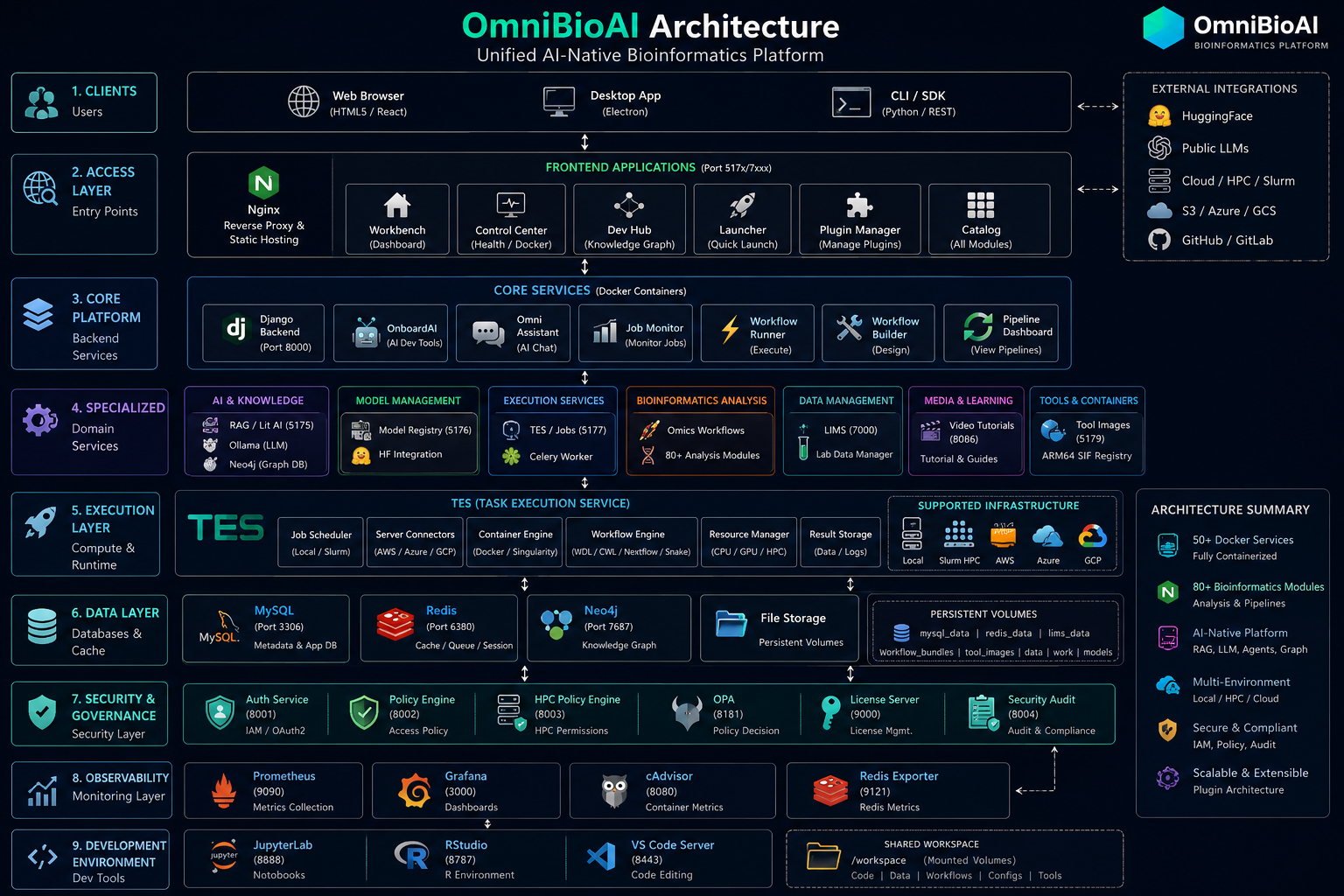
AI-native computational biology architecture spanning scientific AI, bioinformatics workflows, execution infrastructure, provenance, security, governance, and observability.
| Repository | Responsibility |
|---|---|
| omnibioai | Main scientific workbench and plugin ecosystem |
| omnibioai-studio | Desktop platform and stack orchestration |
| omnibioai-control-center | Operations, security, readiness, and platform observability |
| omnibioai-workbench | Scientific plugin and analysis execution |
| omnibioai-launcher | Jupyter, VS Code, and RStudio integration |
| omnibioai-sdk | Python platform SDK |
| omnibioai-utils | Platform automation, CI/CD, lifecycle and coverage tooling |
| Repository | Responsibility |
|---|---|
| omnibioai-tes | Unified local/HPC/cloud Tool Execution Service |
| omnibioai-toolserver | Governed tool API |
| omnibioai-tool-runtime | Container execution runtime |
| omnibioai-tool-images | Bioinformatics and ML execution images |
| omnibioai-workflow-bundles | Versioned reproducible workflows |
| Repository | Responsibility |
|---|---|
| omnibioai-rag | Biomedical retrieval-augmented generation |
| omnibioai-dev-hub | Semantic development and AI intelligence services |
| omnibioai-model-registry | Governed model lifecycle and provenance |
| Repository | Responsibility |
|---|---|
| omnibioai-auth | Authentication and identity |
| omnibioai-api-gateway | Zero-trust API gateway |
| omnibioai-policy-engine | RBAC/ABAC policy enforcement |
| omnibioai-hpc-policy-engine | Computational quota governance |
| omnibioai-security-audit | Durable security-event processing |
| omnibioai-security-sdk | Shared security primitives |
| omnibioai-iam-client | IAM client SDK |
| omnibioai-usage-client | Usage-event SDK |
| Repository | Responsibility |
|---|---|
| omnibioai-lims | Biological sample and metadata management |
| omnibioai-data | Reference and example datasets |
| omnibioai-docs | Technical documentation |
| omnibioai-videos | Tutorials and onboarding |
Scientific Computing
Python · R · Bioinformatics tools · Multi-omics
Backend
FastAPI · Django · MySQL · Redis · Redis Streams
AI
LLMs · RAG · Vector Search · Knowledge Graphs · Scientific Agents
Workflow
Nextflow · WDL · Snakemake · CWL
Infrastructure
Docker · Apptainer/SIF · Kubernetes · Slurm · AWS Batch · Azure Batch
Frontend
React · TypeScript · Vite
Security
IAM · JWT · RBAC · ABAC · SAML · Service Identities · Audit · Policy Enforcement
Scientific results should carry enough execution context to be reproduced and audited.
AI assists scientific workflows, but deterministic tools remain the execution authority.
Scientific interpretation should be connected to evidence and provenance.
Users and services receive only the permissions and resources required for their responsibilities.
AI-generated scientific interpretations remain subject to human review.
A control is not considered operational simply because its source code exists or its unit tests pass.
🌐 Website https://omnibioai.org
📊 Platform Control Center https://control.omnibioai.org
🐙 GitHub https://github.com/OmniBioAI
📦 Container Registry https://github.com/orgs/OmniBioAI/packages
🤗 Hugging Face https://huggingface.co/omnibioai
📚 Documentation
See omnibioai-docs
🎥 Tutorials
See omnibioai-videos
💬 Discord https://discord.gg/Hu6vgfAFn
🐦 X / Twitter https://twitter.com/OmniBioAI
Manish Kumar
Senior Computational Scientist · AI-Native Bioinformatics Engineer
18 years of experience spanning bioinformatics, multi-omics, computational biology, HPC, cloud computing, and scientific AI across the United States, Qatar, Malaysia, Saudi Arabia, and India.
Creator and lead engineer of OmniBioAI Studio.
Building computational systems at the intersection of:
Biology × AI × Software Engineering × HPC × Reproducibility
Build the computational operating layer where biological data, scientific workflows, reproducible execution, and artificial intelligence converge to accelerate biomedical discovery.
⭐ Explore the platform, architecture, workflows, and open-source ecosystem.