feat(native): evaluate prefers-reduced-motion so motion-reduce / motion-safe work on native - #388
YevheniiKotyrlo wants to merge 3 commits into
Conversation


Only prefers-color-scheme was wired into the native media-query
evaluator (via Appearance). prefers-reduced-motion had no observable
and no evaluator case, so `motion-reduce:` / `motion-safe:` (and any
@media (prefers-reduced-motion) rule) compiled cleanly and then
resolved to false on every device -- a silent no-op off the web.

Mirror the colorScheme wiring: a reduceMotion observable seeded from
AccessibilityInfo.isReduceMotionEnabled() and kept live via the
reduceMotionChanged event, plus a prefers-reduced-motion case in
testComparison handling reduce and no-preference. Also handle the
bare `@media (prefers-reduced-motion)` boolean form (per CSS, bare is
equivalent to reduce).

Adds runtime tests (reduce, no-preference, composition, negation,
bare) mirroring the existing color-scheme test, plus a compiler test
asserting the emitted media condition.
Note that AccessibilityInfo has no synchronous getter (unlike
Appearance.getColorScheme()), so the observable seeds `false` and
flips when the async read resolves -- a brief, inherent cold-start
window. Comment-only; no behaviour change.

…xactly

Two defects in the original, both measured.

The seed reached out to AccessibilityInfo unguarded at module scope. This module
is the root of every media feature, so on a host without a native
AccessibilityInfo the missing getter took colorScheme, vw/vh and containers down
with it at import — and a rejecting getter killed the process outright, since
nothing attached a catch. Both now guarded.

The comparison arm was a two-way branch on `no-preference`, so it answered
`get(reduceMotion)` for every other value — `(prefers-reduced-motion: anything)`
matched whenever the flag was on. The compiler emits `["=", name, value]` with no
allowlist, so that condition is reachable. An equality test makes an unrecognised
value false, as MQ5 requires.

Three tests cover what nothing did: that the observable is wired to
AccessibilityInfo at all — deleting either the seed or the listener was green
before — that the cold-start default survives its own beforeEach, and that an
absent or rejecting getter leaves the module importable.

The Android comment named the wrong setting. AccessibilityInfoModule reads
Settings.Global.TRANSITION_ANIMATION_SCALE, not the animator duration scale; the
cited react-native#31221 is precisely about the two disagreeing.
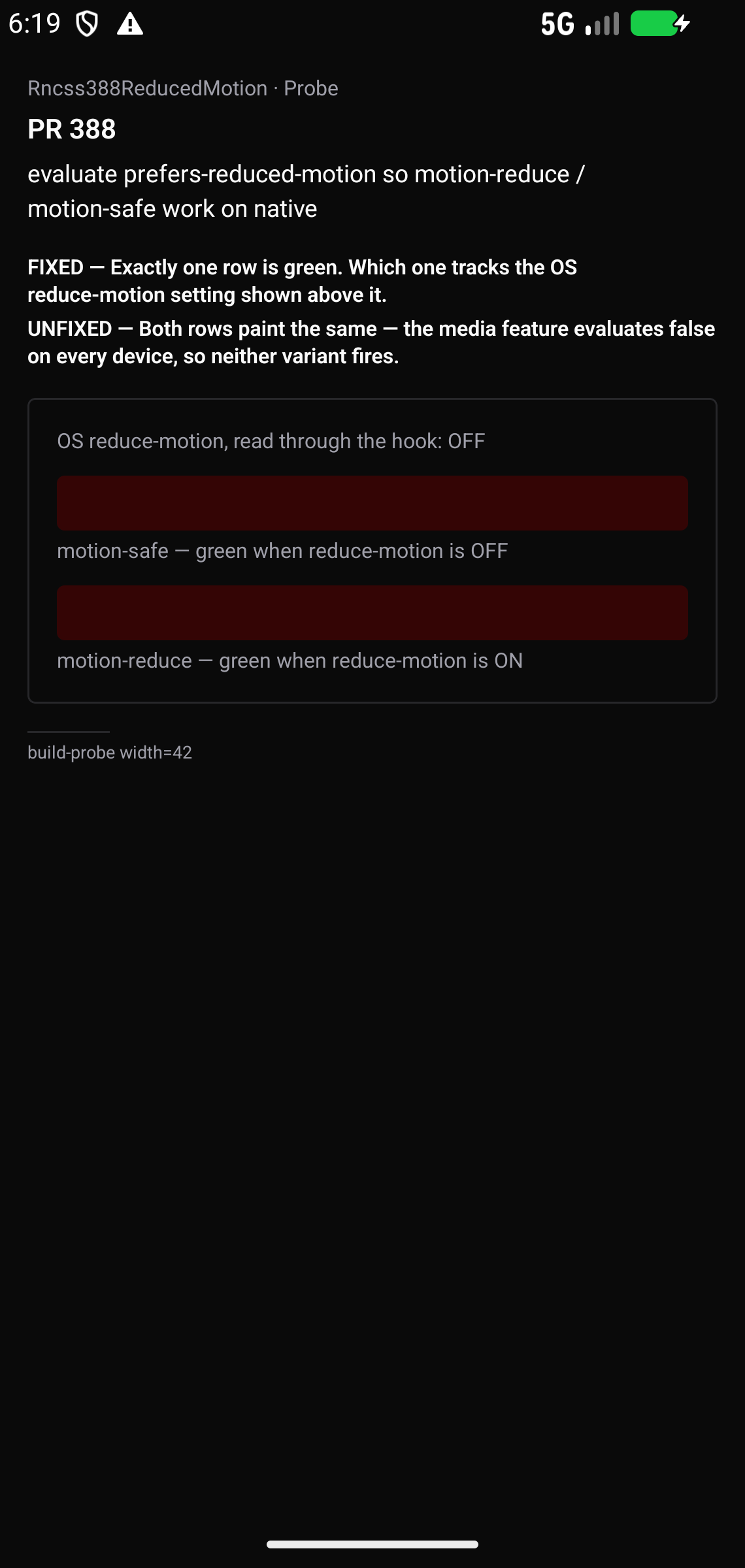
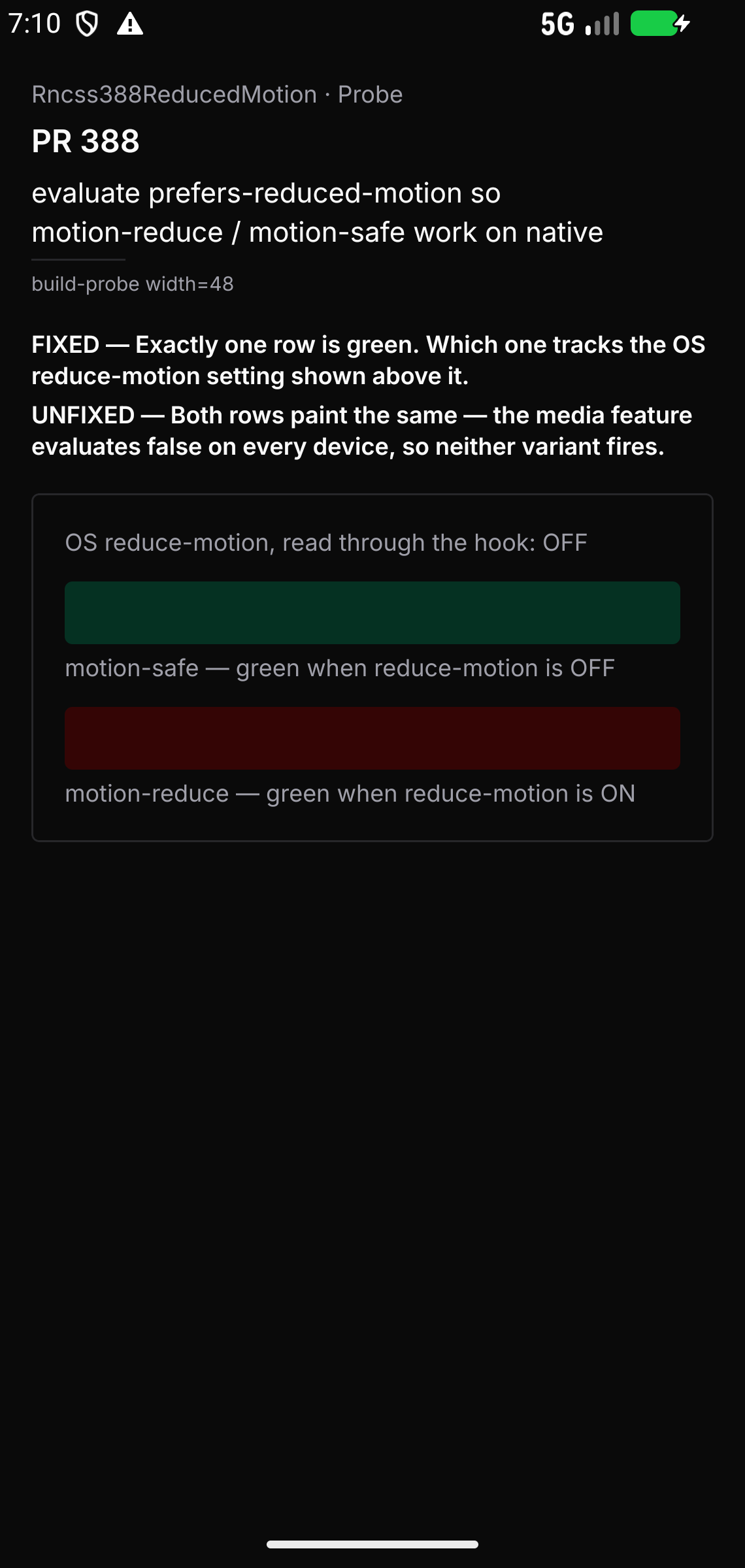
Device evidence — before / afterUNFIXED — Both rows paint the same — the media feature evaluates false on every device, so neither variant fires. FIXED — Exactly one row is green. Which one tracks the OS reduce-motion setting shown above it.
Both frames come from the same device in the same run (Android 36 emulator, 1140×2400 @ 480dpi). Each frame carries a |
|
@danstepanov — I've added before/after device captures to 19 of my 26 open PRs here. Each pair is the same device in the same run, differing only in whether the patch is applied, so the difference should be quick to eyeball. The other seven (#390, #410, #427, #428, #429, #430, #432) have nothing visual to show — they're build, typing and resolution fixes. No rush at all, and happy to rebase or split any of them if that makes them easier to take. |
This branch has not been deployed
1 participant

Problem
react-native-cssevaluatesprefers-color-schemeon native (viaAppearance) but has no wiring forprefers-reduced-motion. So Tailwind'smotion-reduce:/motion-safe:variants — and any authored@media (prefers-reduced-motion)rule — compile correctly and then resolve tofalseon every device, silently. Web works because the browser evaluates the real CSS.This adds the missing feature, mirroring the existing
prefers-color-schemewiring exactly:src/native/reactivity.ts— areduceMotionobservable seeded fromAccessibilityInfo.isReduceMotionEnabled()and kept live via thereduceMotionChangedevent — the mirror ofcolorScheme←Appearance.src/native/conditions/media-query.ts— aprefers-reduced-motioncase intestComparison, handling bothreduce(motion-reduce:) andno-preference(motion-safe:), plus the bare@media (prefers-reduced-motion)boolean form (per CSS, bare(prefers-reduced-motion)≡reduce).get(reduceMotion)subscribes the effect, so a runtime OS toggle re-renders exactly as acolorSchemechange re-rendersdark:.Why it matters
motion-reduce:/motion-safe:are the documented Tailwind way to honour WCAG 2.3.3 (reduced motion). Verified against Tailwind v4.3.2 —motion-reduce:*emits@media (prefers-reduced-motion: reduce)andmotion-safe:*emits@media (prefers-reduced-motion: no-preference). Today both are dead on native: every reduced-motion affordance a consumer writes is a no-op off the web.Normatively this is MQ5 §12.1 —
prefers-reduced-motionis a user-preference media feature the page is expected to answer, not a value a build can fold away.Solution
Three commits. The media feature is evaluated on native rather than compiled away, seeded once at cold start from
AccessibilityInfo.isReduceMotionEnabled()and kept current from its change event.The seed is guarded and the value compared exactly:
AccessibilityInforesolves asynchronously and can answer before the observable exists, so an unguarded seed writes into nothing, and a loose comparison treatsundefinedasfalse— which reports "motion is fine" for a device that never answered.Tests
describe("prefers-reduced-motion")block insrc/__tests__/native/media-query.test.tsx(5 tests), mirroring the existing"color scheme"test:reduce(motion-reduce:) — base style by default, reduced style afterreduceMotion.set(true), and back (reactive both ways).no-preference(motion-safe:) — the inverse.prefers-color-schemeviaand.not (prefers-reduced-motion: reduce).@media (prefers-reduced-motion).prefers-reduced-motiontest insrc/__tests__/compiler/compiler.test.tsx(mirrorslight-dark()) asserting the emitted media condition:["=", "prefers-reduced-motion", "reduce" | "no-preference"]and the bare["!!", "prefers-reduced-motion"].yarn test,yarn typecheck,eslint,prettier --checkall pass. (The three babel suites fail identically on cleanmainin this environment — missing--experimental-vm-modules— and are unrelated to this change.)Mutation-proved: reverting this branch's
src/diff and re-running these files alone turns 10 of 34 red. The rest stay green, so the set is not simply coupled to the change.Verification
tsc --noEmit0 errors ·eslint0 problems ·jest1059 passed, 3 failed, 21 skipped.The 3 are the Windows-only
babel-plugin-testercases over an unrewritten relativerequire("../View"); they fail identically at every ref on this machine and this branch touches no babel file. #390 is the branch that fixes them.Known limits
AccessibilityInfo.isReduceMotionEnabled()is async-only (no synchronous getter, unlikeAppearance.getColorScheme()), so the observable seedsfalseand flips when it resolves — a one-frame cold-start window, withfalse(motion on) as the safe default.AccessibilityInforeact/react-native#31221); iOS drives it directly. This mirrors React Native's ownAccessibilityInfobehaviour and is out of scope here.Base
Branched off
f70c402.mainhas since taken #451 (a5002c5). 3 of the 5 files this changes also moved there (src/__tests__/compiler/compiler.test.tsx,src/native/conditions/media-query.ts,src/native/reactivity.ts), and it still merges cleanly onto currentmain. Every measurement above was taken onf70c402. Say the word and I will re-apply it onto currentmain.